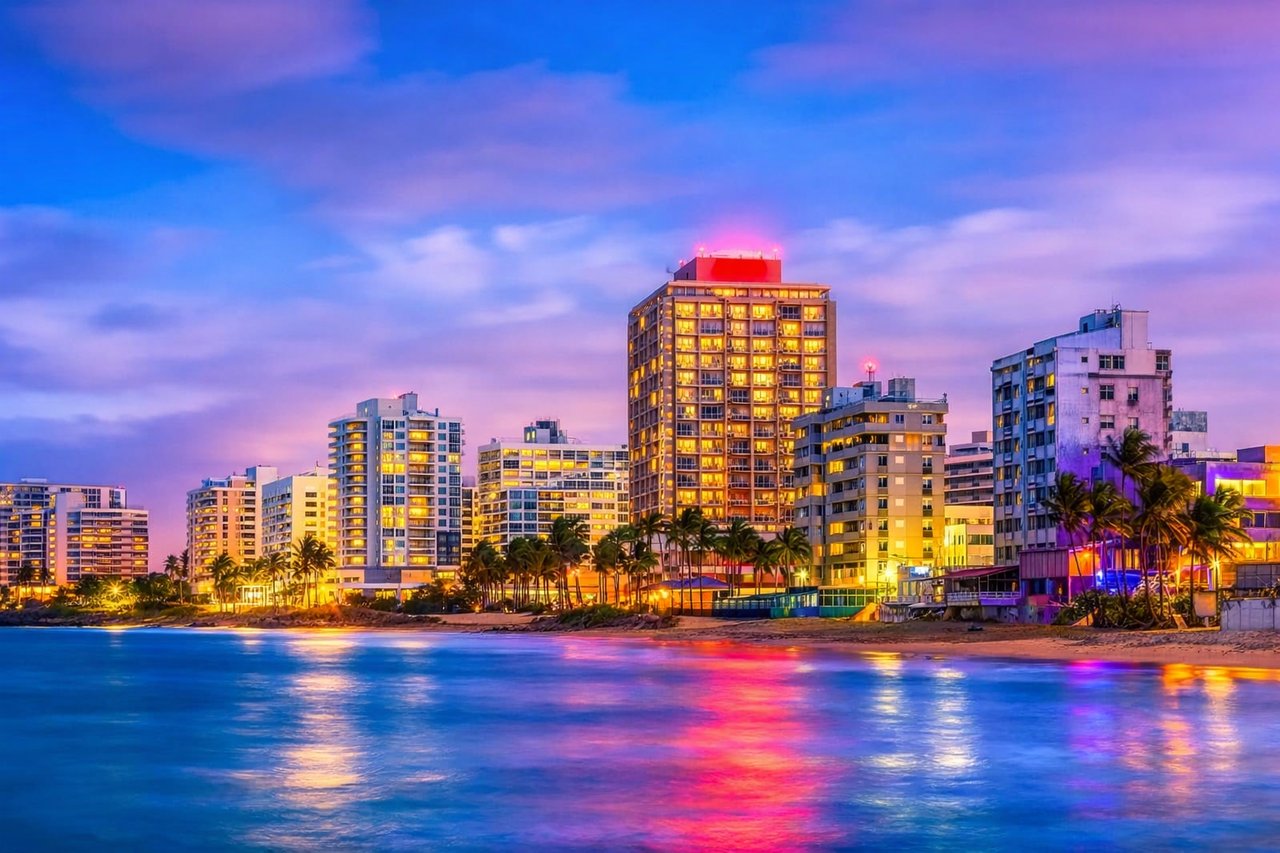
From Miami to Puerto Rico: A Market at an Earlier Stage of the Same Cycle
For decades, Miami has been the benchmark for tropical, tax-efficient U.S. real estate. Today, sophisticated investors are asking a more forward-looking question:
Where is the next market with similar structural tailwinds, but greater room to grow?
Puerto Rico is increasingly part of that conversation. Not as a replacement for Miami, but as a market at an earlier stage of a comparable cycle, with meaningful upside still ahead.
The Blueprint: What Drove Miami’s Surge
Over the past decade, Miami experienced a 188 percent surge in residential real estate values. That growth was driven by fundamentals:
- Constrained inventory meeting sustained demand
- Significant inbound migration
- Florida’s absence of state income tax
- Strong rental yields
- Institutional-quality new development
- Large-scale deployment of global capital
While headlines focused on purchases by figures such as Ken Griffin, Jeff Bezos, and Mark Zuckerberg, the broader story was structural. International buyers absorbed a substantial share of new construction, particularly from Latin America, seeking stability, dollar-denominated assets, and lifestyle alignment.
When tax efficiency, capital migration, lifestyle appeal, and limited supply converge, markets reprice.
Puerto Rico: Similar Dynamics, Different Entry Point
Puerto Rico shares many of Miami’s core attributes — climate, cultural depth, U.S. legal framework, and accessibility — but adds a structural differentiator: Act 60.
For the past decade, Act 60 has driven a significant portion of high-end demand, particularly in communities like Dorado Beach, where transactions have surpassed $10 million and reset pricing expectations island-wide.
However, the narrative is evolving.
While incentives remain powerful, the next chapter of growth appears to be less dependent on tax positioning alone and more connected to placemaking, hospitality, and global brand validation.
From Incentive Story to Destination Story
New internationally backed developments such as Moncayo and Esencia reflect a shift in the type of capital entering the market. These projects are not simply responding to relocation demand; they are building institutional-grade environments designed to compete globally.
As Will Bennett, CEO of Three Rules Capital explains:
“Puerto Rico is entering a fundamentally different chapter, where demand is being driven not by tax incentives alone, but by the creation of places that can stand shoulder to shoulder with the finest destinations in the world. For too long, the island’s extraordinary natural beauty, rich culture, and the warmth of its people were underappreciated on the global luxury stage, but that is now beginning to change. When globally recognized hospitality brands and long-term institutional capital commit to Puerto Rico, it signals permanence and quality, and attracts buyers who are drawn not just to an investment, but to a place they genuinely want to belong.”
This distinction is critical.
Markets evolve from opportunistic to institutional when buyers participate because of asset quality and long-term vision — not solely because of financial engineering.
Puerto Rico is approaching that inflection point.
The Role of Global Hospitality and Institutional Capital
The presence of brands such as Ritz-Carlton Reserve and Four Seasons reinforces this trajectory. Global hospitality operators do not deploy capital lightly. Their involvement signals durability, standards, and international visibility.
When long-term institutional capital aligns with globally recognized brands, perception changes. And in luxury markets, perception is often the precursor to repricing.
The Growth Differential
Miami is now a mature global gateway city. Values reflect its position.
Puerto Rico, by contrast, remains earlier in its expansion cycle:
- Lower relative entry points compared to prime South Florida
- Scarcity of true institutional-grade luxury inventory
- Expanding hospitality footprint
- Increasing migration of founders, fund managers, and globally mobile families
- Continued infrastructure and amenity investment
For disciplined investors, earlier-stage markets with strengthening fundamentals often present asymmetric upside.
A Market Still Underowned
Unlike Miami, Puerto Rico remains underrepresented in global portfolios. For many international buyers, it is still discovery-driven rather than default allocation.
That underexposure can create opportunity.
If wealth migration patterns continue — whether from high-tax U.S. states or from international markets seeking stability — capital will look for jurisdictions that combine legal certainty, lifestyle alignment, and long-term growth potential within a U.S. framework.
Puerto Rico sits uniquely at that intersection.
The Long-Term View
This is not about declaring Puerto Rico “the next Miami.” Markets do not replicate perfectly.
It is about recognizing parallel structural forces and understanding that Puerto Rico is earlier in its growth trajectory, with greater elasticity in pricing and room for expansion.
From our vantage point in the luxury segment, buyer profiles are evolving, institutional confidence is strengthening, and the ceiling continues to move.
Puerto Rico is no longer solely an incentive story.
It is becoming a globally relevant destination, and an emerging asset class in its own right.
